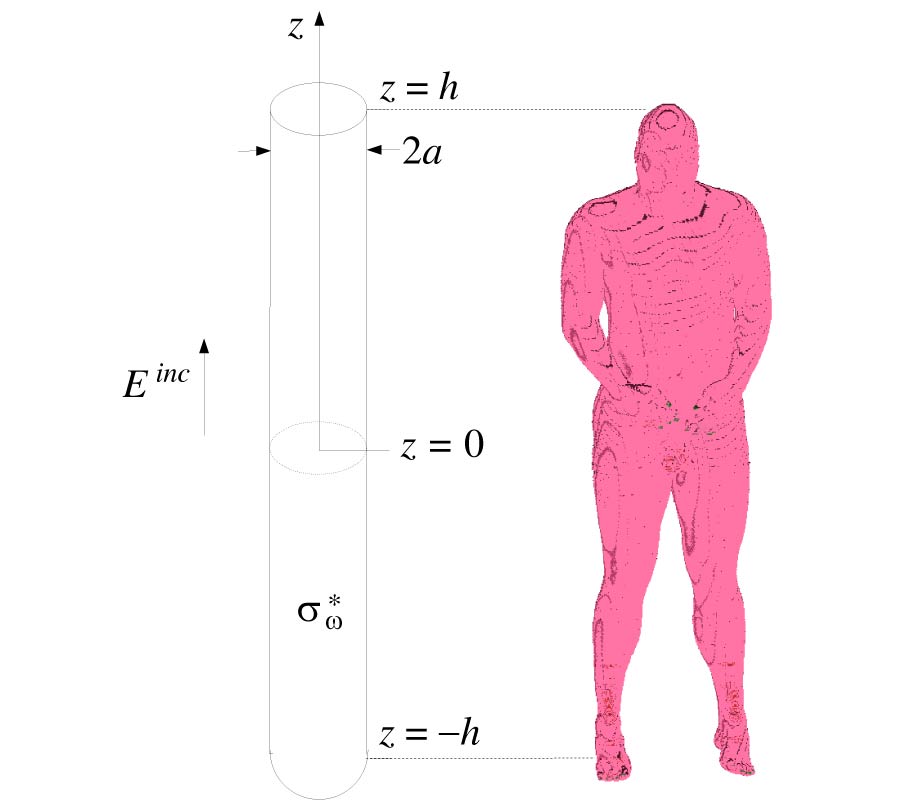
1., ICNIRP (International Commission on Non-Ionising Radiation Protection), "Guidelines for limiting exposure to time-varying electric, magnetic, and electromagnetic fields (up to 300 GHz)," Health Phys., Vol. 74, No. 4, 494-522, 1998. Google Scholar
2., IEEE (Institute of Electrical and Electronics Engineers), "IEEE standard for safety levels with respect to human exposure to radio frequency electromagnetic fields, 3 kHz to 300 GHz," Health Phys., C95-1, 2005. Google Scholar
3. Durney, C. H., "Electromagnetic dosimetry for models of humans and animals: A review of theoretical and numerical techniques," Proc. IEEE, Vol. 68, 33-40, 1980.
doi:10.1109/PROC.1980.11578 Google Scholar
4. Ghandi, O. P., "State of the knowledge for electromagnetic absorbed dose in man and animals," Proc. IEEE, Vol. 68, No. 1, 24-32, 1980.
doi:10.1109/PROC.1980.11577 Google Scholar
5. Dimbylow, P. J., "FDTD calculations of the whole-body average SAR in an anatomically realistic voxel model of the human body from 1MHz to 1 GHz," Phys. Med. Biol., Vol. 42, No. 3, 479-490, 1997.
doi:10.1088/0031-9155/42/3/003 Google Scholar
6. Dimbylow, P. J., "Fine resolution calculations of SAR in the human body for frequencies up to 3 GHz," Phys. Med. Biol., Vol. 47, No. 16, 2835-2846, 2002.
doi:10.1088/0031-9155/47/16/301 Google Scholar
7. Wang, J., O. Fujiwara, S. Kodera, and S. Watanabe, "FDTD calculation of whole-body average SAR in adult and child models for frequencies from 30MHz to 3 GHz," Phys. Med. Biol., Vol. 51, No. 17, 4119-4127, 2006.
doi:10.1088/0031-9155/51/17/001 Google Scholar
8. King, R. W. P. and S. S. Sandler, "Electric fields and currents induced in organs of the human body when exposed to ELF and VLF electromagnetic fields," Radio Science, Vol. 31, No. 5, 1153-1167, 1996.
doi:10.1029/96RS01313 Google Scholar
9. Poljak, D. and V. Roje, "Currents induced in human body exposed to the power line electromagnetic field," Proc. 20th Annu. Conf. IEEE Eng. Med. Biol. Soc., Vol. 6, 3281-3284, 1998. Google Scholar
10. Ghandi, O. P. and J. Chen, "Numerical dosimetry at power-line frequencies using anatomically based models," Bioelectromagnetics Suppl., Vol. 13, No. S1, 43-60, 1992.
doi:10.1002/bem.2250130706 Google Scholar
11. King, R. W. P., "Electric current and electric field induced in the human body when exposed to an incident electric field near the resonant frequency," IEEE Trans. Microwave Theory and Tech., Vol. 48, No. 9, 1537-1543, 2000.
doi:10.1109/22.869005 Google Scholar
12. Ghandi, O. P., J. Chen, and A. Riazi, "Currents induced in a human being for plane-wave exposure conditions 0-50MHz and for RF sealers," IEEE Trans. Biomed. Eng., Vol. 33, No. 8, 757-767, 1986. Google Scholar
13. Dimbylow, P. J., A. Hirata, and T. Nagaoka, "Intercomparison of whole-body averaged SAR in European and Japanese voxel phantoms," Phys. Med. Biol., Vol. 53, No. 20, 5883-5897, 2008.
doi:10.1088/0031-9155/53/20/022 Google Scholar
14. Nagaoka, T., S. Watanabe, K. Sakurai, E. Kunieda, S. Watanabe, M. Taki, and Y. Yamanaka, "Development of realistic high-resolution whole-body voxel models of Japanese adult males and females of average height and weight, and application of models to radio-frequency electromagnetic-field dosimetry," Phys. Med. Biol., Vol. 49, No. 1, 1-15, 2004.
doi:10.1088/0031-9155/49/1/001 Google Scholar
15. Gabriel, S., R. Lau, and C. Gabriel, "The dielectric properties of biological tissues: III. Parametric models for the dielectric spectrum of tissues," Phys. Med. Biol., Vol. 41, No. 11, 2271-2293, 1996.
doi:10.1088/0031-9155/41/11/003 Google Scholar
16. Taylor, C. D., W. H. Charles, and A. A. Eugene, "Resistive receiving and scattering antenna," IEEE Trans. Antennas Propag., Vol. 15, No. 3, 371-376, 1967.
doi:10.1109/TAP.1967.1138944 Google Scholar
17. King, R. W. P. and S. Prasad, Fundamental Electromagnetic Theory and Applications, Prentice-Hall, Englewood Cli®s, USA, 1986.
18. Heymsfield, S. B., A. Martin-Nguyen, T. M. Fong, M. Tung, D. Gallagher, and A. Pietrobelli, "Body circumferences: Clinical implications emerging from a new geometric model," Nutr. Metab., Vol. 5, 24, 2008.
doi:10.1186/1743-7075-5-24 Google Scholar
19. Martinsen, O. G., S. Grimnes, and H. P. Schwan, "Interface phenomena and dielectric properties of biological tissue," Encyclopedia of Surface and Colloid Science, Vol. 20, 2643-2653, 2002. Google Scholar
20. Hume, R., "Prediction of lean body mass from height and weight," J. Clin. Pathol., Vol. 19, No. 4, 389-391, 1966.
doi:10.1136/jcp.19.4.389 Google Scholar
21. Hirata, A., O. Fujiwara, T. Nagaoka, and S. Watanabe, "Estimation of whole-body average SAR in human models due to plane-wave exposure at resonance frequency," IEEE Trans. Electromagn. Compat., Vol. 52, No. 1, 41-48, 2010.
doi:10.1109/TEMC.2009.2035613 Google Scholar
22. Nagaoka, T., E. Kunieda, and S.Watanabe, "Proportion-corrected scaled voxel models for Japanese children and their application to the numerical dosimetry of specific absorption rate for frequencies from 30MHz to 3 GHz," Phys. Med. Biol., Vol. 53, 6695-6711, 2008.
doi:10.1088/0031-9155/53/23/004 Google Scholar
23. El Habachi, A., E. Conil, A. Hadjem, E. Vazquez, F. M. Wong, A. Gati, G. Fleury, and J. Wiart, "Statistical analysis of whole-body absorption depending on anatomical human characteristics at a frequency of 2.1 GHz," Nutr. Metab., Vol. 55, No. 7, 1875-1887, 2010. Google Scholar
24. Long, S. A., M. W. McAllister, and L. C. Shen, "The resonant cylindrical dielectric cavity antenna," IEEE Trans. Antennas Propag., Vol. 31, No. 3, 406-412, 1983.
doi:10.1109/TAP.1983.1143080 Google Scholar
25. Balanis, C. A., Antenna Theory: Analysis and Design, John Wiley & Sons, New Jersey, USA, 2005.
26. Kibret, B., A. K. Teshome, and D. T. H. Lai, "Human body as antenna and its effect on human body communications," Progress In Electromagnetics Research, Vol. 148, 193-207, 2014.
doi:10.2528/PIER14061207 Google Scholar